
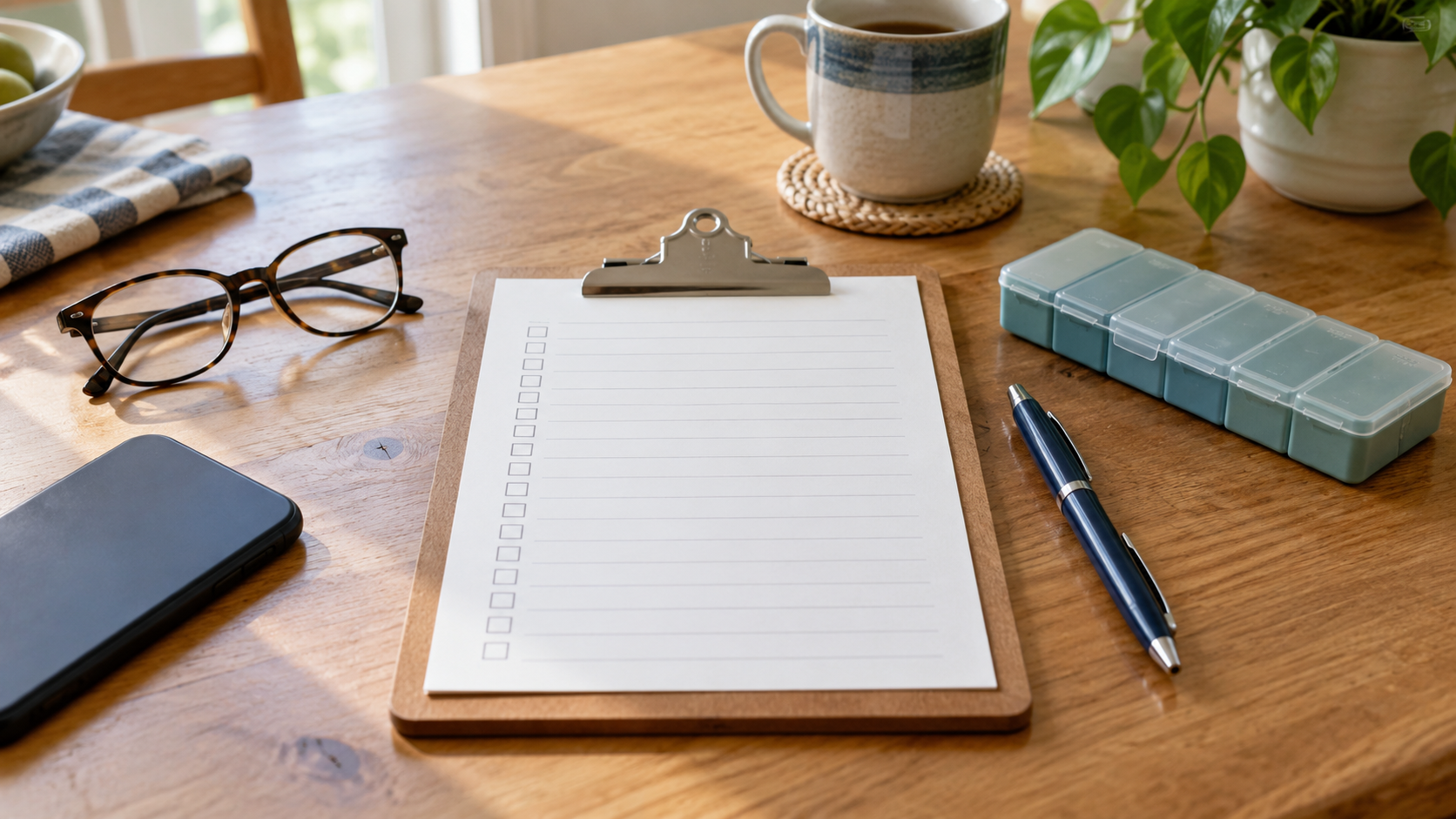
A medication list can be small enough to fit in a wallet and still make an important difference. When a clinician, pharmacist, caregiver, or emergency worker needs to understand what you use, memory is a fragile tool—especially when you are tired, rushed, or unwell. A current list gives the conversation a reliable starting point.
The goal is not a perfect medical file; it is a clear snapshot someone can use. The U.S. Food and Drug Administration (FDA) recommends keeping a record of prescription and nonprescription medicines, vitamins, and supplements, and reviewing it when something changes. This article offers a practical way to build that record. It does not replace advice from your prescriber or pharmacist.
Start with every product, not just prescriptions
Gather the medicine containers, a notes app, or pharmacy records that you already use. Include prescription medicines, over-the-counter products, vitamins, minerals, herbal products, and other dietary supplements. If you use something only occasionally—such as a pain reliever, sleep aid, antacid, or allergy product—include it and mark it as “as needed.”
This fuller view matters because a pharmacist or clinician may need to consider more than the medicines prescribed by one office. The FDA specifically advises listing prescription and nonprescription medicines, vitamins, and supplements. Avoid guessing from memory: read the label or ask a pharmacy to help clarify a product name.
Use one row for each item
Choose a format you will actually maintain: a paper page, a simple document, or a secure app. For each item, record the name, strength, amount, timing or schedule, and the reason you take it if you know it. For prescriptions, it can also be useful to note the prescriber and pharmacy. Keep the wording plain enough that another person could read it.
Do not rewrite label directions in a way that changes their meaning. If anything is unclear—whether a dose, timing, or instruction—ask the pharmacist or prescriber rather than trying to interpret it. A list is a communication tool, not a reason to adjust treatment on your own.
Add allergies and key context
At the top of the page, write medication allergies or past reactions and describe the reaction if you know it. Add relevant emergency contacts and, if useful, the names of regular clinicians. Keep the information focused: someone reading the list should be able to find the essentials quickly.
If you support another adult, make a separate list for each person. Combining everyone’s medicines on one page makes an already stressful situation harder to sort out. Ask the person what they are comfortable sharing and where the list should be kept.
Make updates part of the routine
A list is most useful when it matches what you are using now. Update it after a new prescription, a dose change, a medicine that is stopped, or a new supplement. The FDA also recommends reviewing the list often and sharing it with health professionals and trusted caregivers.
Give the list an “updated on” date. That small detail helps you notice when the information is stale. A simple prompt in your calendar—perhaps after an appointment or when you collect a refill—can be enough to keep it current.
Keep a copy where it can be found
Use two formats if that helps: one copy at home and one that travels with you, such as a wallet card or a photo saved on your phone. Keep digital copies private and protected in a way that suits your device. Tell one trusted person where the current version is stored.
Bring the list to appointments and pharmacies, including appointments that may not seem directly related to medicines. The National Institute on Aging advises bringing names, doses, and schedules for medicines, vitamins, herbal remedies, over-the-counter drugs, and supplements to appointments. The list is also a useful prompt for your own questions.
Use it to ask better questions
When a new medicine is suggested, the list helps you ask practical questions: What is this for? How and when should I take it? What should I do if I miss a dose? Are there interactions or side effects I should discuss? The FDA encourages people to share a complete record with their pharmacist and other health professionals.
Write down the answer or ask for written instructions if that works better for you. If a concern is urgent, contact a healthcare professional, pharmacist, or local emergency service as appropriate. Do not wait for a scheduled list review to raise a serious reaction or problem.
A ten-minute reset
Set a timer, pull together the containers you use, and compare each one with your list. Cross out anything that has ended, add anything new, and date the page. Then put it back in its usual place. The habit is deliberately modest: a list that stays current is more valuable than an elaborate system that is never opened.
Sources and further reading
- U.S. Food and Drug Administration: Create and Keep a Medication List for Your Health
- U.S. Food and Drug Administration: talking with your pharmacist about medicines
- National Institute on Aging: tips for taking someone to a doctor’s appointment
Frequently asked questions
What belongs on a medication list?
Include prescription medicines, over-the-counter products, vitamins, minerals, herbal products, and other supplements. For each, note the name, strength, amount, and schedule; add why it is used if known.
Should I list medicines I take only occasionally?
Yes. Mark them as “as needed” and include how you use them. Occasional products can still matter when a pharmacist or clinician is reviewing the whole picture.
How often should I update the list?
Update it whenever you start, stop, or change a medicine or supplement. A quick review after appointments or refills is a practical backup habit.
Can I keep the list on my phone?
Yes, if that is easy for you to access and keep private. Consider also carrying a paper copy or telling a trusted person where an up-to-date copy can be found.
What if I am unsure why I take a medicine?
Do not guess. Ask the pharmacist or prescriber to explain the medicine’s purpose and directions, then record the information in words you can understand.
Does a medication list replace bringing the containers?
No. The list improves communication, but a clinician or pharmacist may still ask to see containers, labels, or pharmacy records. Bring what you can and use the list as a clear summary.
Leave a Reply
You must be logged in to post a comment.