
Category: Uncategorized

  • A Practical Household Emergency Plan You Can Finish in One Evening

    A Practical Household Emergency Plan You Can Finish in One Evening

    Most emergency planning fails for a very ordinary reason: it tries to solve every possible situation at once. A better starting point is a short household plan that answers a few practical questions before a storm, outage, fire, or evacuation makes those questions harder.

    This is not a prediction exercise and it is not a substitute for instructions from local authorities. It is a way to make the first decisions less improvisational. A plan becomes useful when it is easy to find and easy to follow.

    Start with the risks closest to home

    Set aside 30 minutes with the people who live in your household. Discuss the events that are most plausible where you live, work, and spend time: perhaps severe weather, a power outage, wildfire smoke, an apartment fire, or a local evacuation. The American Red Cross recommends discussing likely emergencies, assigning responsibilities, and practicing the plan; Ready.gov similarly emphasizes planning, supplies, and staying informed.

    Keep the discussion specific. Ask: What would tell us to leave? What would tell us to stay put? Who might need extra help? Where are the exits, and who is responsible for pets, medications, or children? Write brief answers rather than trying to create a perfect manual.

    Choose two meeting places and one contact

    Pick one meeting place immediately outside the home for a sudden event such as a fire. Pick another away from the neighborhood in case returning home is not possible. Add one out-of-area contact who can receive updates if household members are separated. Put the same names and phone numbers in each person’s phone and on a small paper card.

    This small amount of redundancy matters. Batteries run down, phones get misplaced, and not everyone will be together when a disruption begins. A paper copy also gives children, guests, or a neighbor something usable without unlocking a device.

    Make leaving easier, not dramatic

    Write down two ways to leave your neighborhood and two possible destinations, such as a trusted friend’s home, a hotel, or an official shelter. Routes and destinations can change, so the value is in knowing what information to check and whom to contact—not in treating a page of notes as permanent instructions.

    Keep keys, shoes, a phone charger, and any mobility aids in locations household members can reach. If someone uses medication, medical equipment, hearing devices, or mobility supports, include their needs in the plan and discuss supply questions with their clinician or pharmacist. Build the plan around real routines, not an imaginary household with unlimited time and storage.

    Build a small, maintainable kit

    A kit does not have to be bought in a single trip. Begin with items you already use: drinking water, shelf-stable food, a flashlight, spare batteries or charging options, a first-aid kit, basic hygiene supplies, and copies of key documents. Add only what suits your household, including infant supplies, pet items, glasses, prescription information, or a manual can opener where useful.

    Store supplies together in a place that is easy to reach. Review food, batteries, and personal items on a calendar date you already remember, such as the start of a season or a birthday month. The Red Cross advises keeping supplies in an easy-to-carry kit that can be used at home or taken during an evacuation.

    Decide how you will receive information

    Agree which official sources you will check during an emergency: local emergency management, weather services, municipal alerts, school notices, or other authorities relevant to your area. Keep a battery-powered or alternative way to receive information if practical. Avoid passing along unverified social posts when people are trying to make quick decisions.

    For a serious or immediate danger, contact local emergency services. Otherwise, let official instructions guide whether to evacuate, shelter, avoid travel, or seek assistance. A household plan should support those instructions, never compete with them.

    Practice the parts that matter

    You do not need a full-scale drill to learn whether a plan works. Try a five-minute walk-through: find the kit, unlock the exits, meet at the chosen point, and check that each person can locate the contact card. Then revise anything confusing. The Red Cross recommends practicing as many elements of a plan as possible, including evacuation routes.

    Keep the final version short—one page for contacts, meeting places, responsibilities, and the kit location. Share it with anyone who regularly cares for children, pets, or a household member. The aim is quiet readiness: enough preparation to make a difficult moment more manageable.

    Sources and further reading

    Frequently asked questions

    How long should a household emergency plan be?

    Keep the working version to one page if possible. It should make contacts, meeting places, responsibilities, and kit locations quick to find; longer background notes can live elsewhere.

    Should every household have the same supplies?

    No. Start with basic supplies, then add items for medications, mobility, infants, pets, dietary needs, or other real household circumstances. Review needs with relevant professionals where appropriate.

    Why choose an out-of-area contact?

    If household members are separated, one agreed contact gives everyone a single place to leave and request updates. Make sure each person has the contact both digitally and on paper.

    How often should we review the plan?

    Review it after a move, a change in household members or medical needs, or a local emergency. A simple seasonal review is also a practical way to check supplies and contact details.

    Do we need to practice an evacuation route?

    Practicing helps reveal locked exits, missing keys, and unclear responsibilities before stress is involved. Use official directions during an actual emergency and adapt if conditions change.

    Where should important documents go?

    Keep copies in a secure, accessible place and include the location in the plan. Consider what you would need to identify household members, manage medications, contact insurers, or prove residence.


  • A Low-Stress Checklist for Updating Your Address After a Move

    A Low-Stress Checklist for Updating Your Address After a Move

    An address update is easier when it is treated as a short sequence rather than one enormous errand. Start with the services that affect money, safety, housing, and time-sensitive communication; then work outward to subscriptions and convenience accounts. A written list turns a moving-week worry into a series of small checks.

    Start with your date and your new address

    Write the exact address in the format your local postal service recognizes, including apartment or unit details. Keep a copy in one secure place so you can paste it consistently into forms. If you are moving in the United States, USPS says a permanent change-of-address request reroutes mail but does not update your address with every organization. Review USPS forwarding options before you rely on mail forwarding as your only notification step.

    Make a short first-priority list

    Begin with employers, banks and card providers, insurers, healthcare providers, schools, government agencies, and any housing or utility provider that needs to reach you. These are not universal categories; use the list that fits your household. For each one, note the preferred update method and the date you completed it. Do not put account numbers on an unsecured paper checklist.

    Use mail forwarding as a safety net, not a finish line

    Forwarding can catch some mail while you update senders directly, but rules and periods differ by service and country. USPS explains that a permanent order generally forwards First-Class Mail for 12 months and periodicals for 60 days, while some mail classes are not covered. Check the current rules for your own service and update important senders directly.

    Protect your identity while you update

    Use official websites or phone numbers from a statement, card, or trusted directory. Be cautious with unsolicited messages saying an address must be verified immediately. A new address can be useful to an impersonator, so avoid sending sensitive documents through ordinary email unless the recipient has given you a secure method. If you need replacement identity records, USAGov explains how to find the right issuing office.

    Set a practical second pass

    After two to four weeks, check your recent mail and account messages. Add organizations you missed, then review memberships, deliveries, loyalty programs, publications, and personal contacts. This second pass is also a good time to remove services you no longer use instead of carrying them to the new address.

    Keep a minimal completion record

    A simple list with organization, date, and confirmation reference is enough. Store it securely and delete it when it is no longer useful. The point is not permanent recordkeeping; it is avoiding duplicate updates and knowing which places still need attention.

    Frequently asked questions

    Does mail forwarding update every account automatically?

    No. Mail forwarding changes routing with the postal service; it does not notify your bank, insurer, employer, or other senders. Update important organizations directly.

    When should I submit a change of address?

    Plan ahead using the lead time your postal service recommends. USPS says forwarding may begin within three business days after a request but advises allowing up to two weeks.

    Which address changes should come first?

    Start with organizations connected to housing, income, finances, insurance, health, and legal or government correspondence. Then handle subscriptions and convenience services.

    Is an online address-change message always legitimate?

    No. Navigate to the organization yourself through a trusted official site, app, statement, or phone number rather than following an unexpected link.

    Should I give every company my new address?

    Only update services you want to keep or that need your current contact details. A move is a useful moment to close unwanted subscriptions.

    What should I save after updating an address?

    Keep only a secure, short-term record of completed updates and any confirmation references. Follow each organization’s instructions if a longer record is needed.

  • A Simple Home Document System You Can Keep Up to Date

    A Simple Home Document System You Can Keep Up to Date

    A document system is useful when it answers two questions quickly: what should I keep, and where can I find it? The goal is not a beautiful archive or a weekend-long sorting project. It is a small, repeatable setup that makes an ordinary task—checking a policy number, replacing a card, preparing a tax return, or leaving home in a hurry—less stressful.

    Start with the documents you already need, then give each group one dependable home. A short review routine matters more than a complicated filing method.

    Begin with a short inventory

    Gather papers from the places they tend to collect: a desk drawer, a bag, the kitchen counter, an email download folder, and any older file box. Do not sort every page yet. Make four temporary piles: identity and family records, home and property records, money and tax records, and health and insurance records.

    The Federal Trade Commission’s guidance on disaster preparation includes copies of key family and financial records such as deeds, titles, insurance information, passports, and employee-benefit records. It also recommends storing important information so it can be reached in an emergency. Read the FTC’s organizing guidance.

    Choose categories that match real life

    Use labels you will recognize without thinking. For many households, five folders are enough:

    • Identity and family: copies or location notes for vital records, passports, and legal documents.
    • Home and property: insurance details, leases or ownership records, warranties, and major repair receipts.
    • Money and taxes: current account information, tax documents, and records that support returns.
    • Health and care: insurance cards or policy details, current prescriptions, and contact information that is useful during travel or an emergency.
    • Action soon: papers that need a response, payment, scan, or decision.

    Keep sensitive originals or full account numbers in the most secure place available to you. A folder system is an organizational aid, not a substitute for appropriate physical and digital security.

    Separate originals, copies, and reference notes

    Not every item needs the same treatment. An original document may need a protected location; a copy can make a task easier; and a simple note can point to where the original is held. For example, a note might say where a deed or will is stored and whom to contact if it is needed. This keeps an everyday folder useful without turning it into a single point of failure.

    For emergency preparation, Ready.gov advises people to secure and copy important papers, keep originals in a protective container or another secure location, and store copies somewhere else. Its disaster checklist is a practical prompt for deciding what belongs in your setup.

    Make one digital backup rule

    Scanning every old page can become a reason to postpone the whole project. Instead, decide which current documents would be hard to replace or urgently useful, scan those first, and use a consistent file name such as 2026-insurance-policy-home.pdf. Protect digital copies with a strong, unique password and the security options offered by the service or device you use.

    Do not send sensitive documents by ordinary email simply because it is convenient. Before sharing a copy, confirm who needs it, how they want to receive it, and whether a less sensitive record would do.

    Build a safe disposal habit

    Organization includes deciding what no longer needs to stay. The FTC advises keeping documents with personal or financial information secure and shredding them when it is time to dispose of them. Its current guidance also distinguishes records that may be useful for a limited period from documents that should be kept while you own an asset or kept permanently. Use the FTC’s current keep-or-shred guide alongside any advice from your tax, legal, insurance, or financial professional that applies to your circumstances.

    Put maintenance on the calendar

    A ten-minute check twice a year is usually enough to keep a simple system honest. Replace expired cards, remove resolved bills, update policy contacts, and add documents created since the last review. If an item is unclear, place it in an “ask or decide” folder rather than letting it return to a loose-paper pile.

    The best system is the one a future version of you can open, understand, and use. Start with one box or folder, a handful of clear labels, and a short date for the next check-in.

    Frequently asked questions

    Should I keep every paper statement?

    No. What to keep depends on the document and your situation. The FTC notes that some routine records can be kept for a limited time, while records tied to taxes, property, legal matters, or identity may need longer retention. Check applicable professional guidance before discarding anything important.

    Where should original vital records go?

    Use a secure location appropriate to the record and your circumstances. Keep a clear note or secure copy that helps you locate the original when needed. Ready.gov recommends protecting important papers and keeping copies in another secure location.

    Is a cloud backup enough?

    A digital backup can be useful, but it should be protected with strong account security and should not be your only plan for every original. Consider what you would need if you could not access a device, password manager, or internet connection immediately.

    What is the first folder to create?

    Create an “action soon” folder. It gives new mail and unresolved paperwork a temporary home, which prevents it from mixing with records you need to retain.

    How often should I review the system?

    Choose a repeatable date, such as the start and end of a year or a seasonal clock change. Review sooner after a move, insurance change, major purchase, marriage, separation, or another event that creates new records.

    How can I dispose of sensitive documents more safely?

    Before discarding paper that contains personal or financial information, destroy it in a way that makes the information unreadable. The FTC specifically recommends shredding such documents when they are no longer needed.

  • How to Prepare for a Routine Health Appointment Without Overcomplicating It

    How to Prepare for a Routine Health Appointment Without Overcomplicating It

    A routine health appointment can arrive at the end of a crowded week, when remembering every question feels harder than it should. A little preparation is not about producing a perfect history or predicting an answer. It is about making the time you have easier to use: bring forward the concern that matters most, have the relevant information ready, and leave knowing what happens next.

    This guide is for planned, non-emergency appointments. If you think you may be experiencing an emergency, use your local emergency service rather than waiting for a routine visit.

    Start a short list before the day of the visit

    Keep one note for the appointment and add to it as things occur to you. The U.S. National Institutes of Health recommends making a list of what you want to discuss and putting the most important concerns first. A list can be plain and brief: a new symptom, a medication question, a change in daily life, or a result you do not understand.

    Give each item a useful shape. Instead of writing only “headaches,” you might note when they started, what seems to make them better or worse, and what you want to ask. This is not self-diagnosis. It simply gives you a clearer starting point for the conversation.

    Choose the first question deliberately

    Appointments have limits. Put the concern you would most regret leaving unspoken at the top of the page, and raise it early. The National Institute on Aging similarly advises people not to wait for a clinician to guess what is important to them. If several matters need attention, ask how they can best be handled: today, through a follow-up, or by another member of the care team.

    Try questions that invite a practical explanation: “What are the next steps?” “What should prompt me to contact the office?” “How will I receive the result?” or “Could you explain that word another way?” Clear questions are not a challenge to the clinician; they are part of shared understanding.

    Bring an accurate medication list

    Bring a current list of prescription medicines, over-the-counter products, vitamins, and supplements, including dose and how often you take them. The NIH notes that some practices may prefer people to bring the medicines themselves, while others ask for a list. When in doubt, call the office ahead of time and ask what they need.

    Also write down allergies, recent changes in medicines, and the names of other clinicians involved in your care if those details are relevant. Do not rely on memory for spelling or doses. A phone note or a printed page is easier to check and update.

    Decide whether a support person would help

    For some visits, another person can provide calm support, take notes, or help recall the plan afterward. NIH and NIMH both suggest that a trusted companion can be useful in this role. Before the appointment, agree on what you want them to do: listen, write down instructions, or remind you to ask a particular question.

    You remain in charge of the conversation. If you want private time with the clinician, say so. If you do not want anyone else present, you can still ask for written instructions or pause to make your own notes.

    Use notes during the conversation

    Keep the page visible and cross off the items you have covered. When a new plan is suggested, capture the essentials: what to do, when to do it, how to get results, and what question remains unanswered. If something is unclear, ask for it to be repeated or written down in a way you can use later.

    A useful closing question is: “Could we go over the next step once more?” It gives you a chance to check your understanding before you leave. If you use a patient portal, ask whether follow-up information or test results will appear there and when.

    Leave with a simple next-step record

    After the appointment, turn your notes into a short record while the conversation is fresh: the date, who you saw, the agreed next action, and any follow-up date. Store it in the same place as your medication list so it is easy to find next time.

    Good preparation does not require a complicated system. One focused list, accurate information, and permission to ask for clarity can make a routine appointment feel less hurried and more usable.

    Sources and further reading

    Frequently asked questions

    1. What should I put on an appointment question list?

    List the concerns, changes, and questions you want to discuss, then put the most important item first. Add brief details that help you explain the issue, such as when it began or what you want clarified.

    2. Should I bring my medicines or a list?

    Bring an accurate list of prescription medicines, over-the-counter products, vitamins, and supplements with doses and timing. Call the practice ahead of time if you are unsure whether it prefers the actual containers as well.

    3. Is it acceptable to take notes during an appointment?

    Yes. Notes can help you record instructions, follow-up actions, and questions to revisit. If you miss something, ask for it to be repeated or written down clearly.

    4. Can someone come with me?

    A trusted person can support you, take notes, or help you remember the plan. Decide their role beforehand, and remember that you can ask for private time with the clinician if you want it.

    5. What should I ask before a medical test?

    Ask why the test is recommended, how to prepare, what it involves, when you can expect results, and how those results will be explained. These are practical questions highlighted by the National Institute on Aging.

    6. What if I do not understand an instruction?

    Say so during the visit. Ask for a plain-language explanation, for the instruction to be repeated, or for written information. Understanding the next step is more useful than leaving with an unclear note.

  • A Weekly Reflection Habit That Helps You Notice What Is Working

    A Weekly Reflection Habit That Helps You Notice What Is Working

    A week can disappear into errands, messages and half-finished plans. A short reflection does not need to turn life into a performance review. It can simply create a pause long enough to notice what helped, what drained you and what deserves another try.

    Research on expressive writing and self-monitoring suggests that putting experiences into words can help people process events and recognize patterns. The useful part is not producing a perfect record; it is returning to a few concrete observations often enough to make better choices.

    Keep the appointment small

    Choose a time that already has a natural edge: Sunday evening, the end of a workday, or the first quiet ten minutes on Monday. Set a timer for ten minutes. A small ritual that happens is more valuable than an ambitious one that waits for the ideal week.

    Use one place for the notes. A notebook, a plain document or a note app all work. Reducing the number of decisions makes it easier to begin.

    Use four honest prompts

    1. What gave me energy? Name a conversation, task, place or routine.
    2. What made the week harder? Describe the friction without trying to solve every part of it immediately.
    3. What did I learn? Keep it specific: a fact, a preference or a boundary.
    4. What is one experiment for next week? Make it observable and small.

    For example, “I will put my phone in another room for the first fifteen minutes of dinner” is easier to test than “I will be less distracted.” Experiments create information. They are not verdicts about your willpower.

    Look for patterns, not a score

    After several weeks, read only the headings or the final experiment line. You may notice that certain commitments regularly cost more than expected, that a walk improves difficult afternoons, or that planning fails when a key task is vague. Those are useful clues, even when the week was messy.

    Avoid treating reflection as a reason to replay every mistake. If a question starts a spiral, switch to a gentler version: “What support would have made this easier?” The aim is learning with enough kindness to return next week.

    Turn one observation into a next step

    End by choosing one action that takes under fifteen minutes or has a clear first move. Put it on a calendar only if a time genuinely helps. Then leave the rest of the page alone. A weekly reflection habit works best when it closes the loop rather than creating a second to-do list.

    Sources for further reading

    Frequently asked questions

    1. How long should a weekly reflection take?

    Ten minutes is enough to answer a few consistent prompts. Increase the time only when the shorter version is already sustainable.

    2. Do I need to write by hand?

    No. The best format is the one you will reopen. Writing by hand, typing, or recording a private voice note can all support a regular review.

    3. What if I miss a week?

    Resume with the current week. Trying to reconstruct every missed day can turn a helpful practice into an administrative task.

    4. Can reflection help with goals?

    It can help you see whether a goal fits your real circumstances and whether a small experiment is worth repeating. It does not replace professional support or a complete plan for complex problems.

    5. What should I do with difficult feelings that come up?

    Name them briefly and add a support-focused question, such as who you could speak with. If distress feels persistent or overwhelming, consider reaching out to a qualified health professional or local support service.

    6. How do I keep the habit from becoming self-criticism?

    Use descriptive language rather than labels. “I postponed the call twice” gives you information; “I am hopeless at calls” does not suggest a practical next step.

  • A Small Attention Reset for Days That Feel Too Fragmented

    A Small Attention Reset for Days That Feel Too Fragmented

    Some days do not feel difficult because there is one enormous task. They feel difficult because attention is asked to restart, again and again. A message arrives while you are writing. A browser tab suggests an unfinished errand. A small question from someone else becomes a new thread to hold in your head. By late afternoon, even a modest task can feel oddly heavy.

    You do not need to become perfectly focused to make the day more workable. You need a reliable way to notice the next meaningful piece of work, protect a short stretch for it, and leave yourself a clear path back when the stretch ends. This is an attention reset: a brief, repeatable transition that lowers the friction of beginning.

    Why restarting feels expensive

    What we casually call multitasking is often rapid switching. The American Psychological Association explains that switching can require both choosing a new goal and activating the rules for the new task. That helps explain the familiar experience of reopening a document and needing a moment to remember what mattered.

    This is not an argument for treating every interruption as a personal failure. Some interruptions are part of caring for people, doing collaborative work, or responding to genuine urgency. The useful question is smaller: which interruptions can wait until the next planned checkpoint? When you decide that in advance, you make fewer decisions while you are already distracted.

    The five-minute reset

    Use this before a task that has started to sprawl, or after an interruption has knocked you sideways. Set a timer for five minutes and move through these steps without trying to solve the whole day.

    1. Name the one task. Write a sentence that begins, “For the next stretch, I am working on …” Make it concrete: draft the introduction, compare the two quotes, pay the electricity bill, or outline the first three slides.
    2. Choose a visible finish line. A finish line is not “make progress.” It is a small observable result: a rough paragraph, a marked-up list, one submitted form, or three decisions recorded.
    3. Park the open loops. On paper or in one notes file, list anything that is pulling at you but does not belong in this stretch. A parking list is not a promise to do everything; it is a place to stop rehearsing it.
    4. Make distraction slightly less convenient. Turn the phone face-down or place it out of reach. Close only the tabs that do not support the chosen task. Silence alerts for the length of the stretch if your role allows it.
    5. Start with the easiest honest action. Open the right file, write the first imperfect sentence, or gather the two materials you need. The aim is movement, not a dramatic burst of willpower.

    Use short focus stretches as experiments

    Pick a length you can actually keep today. For one person that may be 15 minutes; for another it may be 40. The number is less important than being able to return after a break. Research on rest intervals and attention suggests that breaks are worth treating thoughtfully rather than as a single universal prescription. Try one length for several days, then ask: did I finish the small finish line, and could I re-enter the task afterward?

    During the stretch, avoid making the plan more elaborate. If you notice a new task, add it to the parking list and return to the current action. If the task itself is unclear, spend the remaining time clarifying it; uncertainty is useful information, not proof that you have failed to focus.

    Make the return easier than the exit

    The last minute of a focus stretch is where many systems quietly break. Before you stand up, leave a breadcrumb for your future self. Write one sentence such as: “Next: choose the clearest example from the interview notes,” or “Next: call the insurer and ask about excess options.” Keep the necessary document open or place the physical materials together.

    This small handoff matters because a return is another switch. A concrete next action reduces the amount of remembering required when you come back. It also makes a short break feel safer: you are not abandoning the work; you have marked the trail.

    Let your environment carry some of the load

    Attention is easier to protect when the room and the tools agree with the task. A writing session may need one document, reference material, and a quiet notification setting. Household admin may need a folder, a notepad, and the relevant account details. Preparing these once is kinder than rebuilding the setup every time.

    If you share your day with other people, a simple signal can help: headphones, a calendar block, a note on the door, or a sentence such as “I can talk at 11:30 unless it is urgent.” The point is not isolation. It is making availability more intentional.

    Finish with a humane review

    At the end of the day, review the system rather than judging yourself. Which interruptions were truly urgent? Which tasks had no clear finish line? Which time of day made it easiest to begin? Change one condition tomorrow. You might move the phone, shorten the first stretch, prepare your materials the night before, or set a single check-in time for messages.

    Fragmented days are normal. A small attention reset will not erase every demand, but it can create one clear place to stand. Start there, then let the next step become visible.

    Sources and further reading

    Frequently asked questions

    1. Is multitasking always bad?

    No. Some activities can be combined safely, and some roles require switching. The practical issue is that switching between demanding tasks can add cognitive load, so it helps to reserve deliberate attention for work where accuracy, judgment, or continuity matters.

    2. How long should a focus stretch be?

    There is no single best duration for everyone or every task. Start with a length you can keep consistently, then observe whether you can complete a small finish line and return after a break. Adjust from evidence in your own day.

    3. Should I use my phone during breaks?

    It depends on your goal. If you want to resume a demanding task, a low-stimulation break such as standing up, drinking water, or looking away from the screen may make the transition back simpler than opening a new stream of messages.

    4. What if I cannot silence notifications?

    Decide which alerts require an immediate response and use a short, clearly communicated window for the rest. If your work is safety-critical or customer-facing, adapt the reset around the obligations rather than ignoring them.

    5. What belongs on a parking list?

    Put down reminders, worries, questions, and unrelated tasks that are competing for attention. Keep entries brief and action-oriented when possible, such as “reply to Sam about Tuesday” rather than a long explanation.

    6. What if I still cannot begin?

    Shrink the action further. Open the document, write a rough heading, or collect one required item. If beginning remains unusually hard for a sustained period or is affecting daily life, consider discussing it with an appropriate qualified health professional.

  • How to Build a Personal Learning Project That Lasts

    How to Build a Personal Learning Project That Lasts

    A personal learning project can begin with a question that keeps returning: How does this work? What would it take to understand this well enough to explain it? The question might be about local history, drawing, public speaking, birds, budgeting, a language, or almost anything else. The hard part is rarely finding information. It is making a small, repeatable practice that can survive ordinary life.

    A good project is not a private version of school. It is a clear promise to yourself: explore one worthwhile subject, make something along the way, and leave enough room to adjust. This guide offers a practical shape for doing that.

    Start with a question, not a curriculum

    Broad ambitions create pressure before they create momentum. “Learn photography” is a large territory; “How can I take better pictures of familiar places in changing light?” gives you somewhere to begin. Choose a question that is specific enough to guide your next session and open enough to reward curiosity.

    Write your question in one sentence. Then add a modest end point: a three-minute explanation for a friend, a short illustrated guide, a set of five observations, or a small finished piece. An end point is not a verdict on your ability. It is simply a reason to gather, test, and organise what you learn.

    Make the project small enough to return to

    Pick a rhythm before you choose a mountain. Two sessions of 25 minutes each week can be more useful than an elaborate plan that never begins. Put the sessions where they can actually happen: after breakfast on Tuesday, during a quiet lunch break, or on Sunday afternoon.

    Give each session one job. Read a short chapter. Watch one lesson and note three ideas. Sketch one object. Practise five phrases aloud. When a session has a finish line, it is easier to start and easier to remember what comes next.

    Use a simple learning loop

    Try this four-part loop: encounter, recall, apply, reflect. First, encounter a useful source or demonstration. Next, close it and write what you remember in your own words. Then apply one idea in a tiny task. Finally, note what was unclear and choose the next small action.

    The recall step matters because recognition can feel like understanding. A major review of learning techniques by Dunlosky and colleagues rated practice testing and distributed practice as high-utility approaches across many conditions. That does not mean every self-quiz is magic; it does suggest that returning to ideas and trying to retrieve them is a more active choice than only rereading notes. The University of Arizona’s learning guidance similarly describes combining spaced practice with retrieval practice as a useful way to revisit material over time. Read the review and the spaced-practice guidance.

    Keep one honest project record

    Use a notebook, plain document, or stack of cards—whatever you will reopen. After each session, record three things: what you did, what surprised you, and the next smallest step. This is not a performance diary. It is a handrail for the day when you forget why you began.

    Include links or titles for sources you may want to revisit. Mark uncertainty rather than disguising it. A note such as “I need a better source for this claim” is evidence of careful learning, not failure.

    Make something before you feel ready

    Creation exposes the useful gaps. Explain the idea aloud, draw the process, label a photograph, solve a small problem, or teach a five-minute version to someone else. Your first attempt can be rough. Its job is to show you what deserves another look.

    Small outputs also make a project more satisfying. They turn a folder of saved links into visible progress and help you decide whether to go deeper, change direction, or finish with a clear conclusion.

    Review the project, not yourself

    Every few weeks, ask practical questions: Is the question still interesting? Does the session length fit my life? Which source or exercise was most useful? What can I remove? Adjust the project rather than treating a missed week as a moral problem.

    A lasting learning project is flexible by design. It has a question, a rhythm, a way to revisit ideas, and a small form of output. Begin with the version you can do this week. The next version will be easier to see once you have made it.

    Frequently asked questions

    1. How long should a personal learning project last?

    Choose a short trial period, such as four weeks, then review it. A limited first cycle gives you enough time to establish a rhythm without pretending you already know the perfect long-term plan.

    2. Do I need a course or formal syllabus?

    No. A question, a small end point, and a dependable source can be enough to start. A course may help with structure, but it is not required for a self-directed project.

    3. What should I do if I miss a session?

    Resume with the next small step. Do not attempt to “catch up” by turning the project into an exhausting block of work; a sustainable rhythm matters more than an unbroken streak.

    4. Why write from memory after studying?

    Writing what you recall helps you distinguish what you recognise from what you can actually explain. It also gives you a concrete list of questions for the next session.

    5. Is rereading enough for learning?

    Rereading can be useful for orientation, but the cited review found stronger general support for practice testing and distributed practice. Pair reading with recall and later revisits rather than relying on rereading alone.

    6. How do I know when the project is finished?

    Finish when you have made the small output you chose and can state what you learned, what remains uncertain, and where someone could continue. You can always begin a new question later.

  • A Practical Way to Make a Life Change Without Trying to Change Everything

    A Practical Way to Make a Life Change Without Trying to Change Everything

    Big intentions can be energising. They can also become so broad that it is hard to know what to do before lunch. If you want to change your work, health, relationships, routines, or creative life, begin by making the next decision smaller and more visible.

    This is not a promise that every change will be easy. It is a way to replace vague pressure with a process you can examine, adapt, and repeat.

    Start with a direction, not a total reinvention

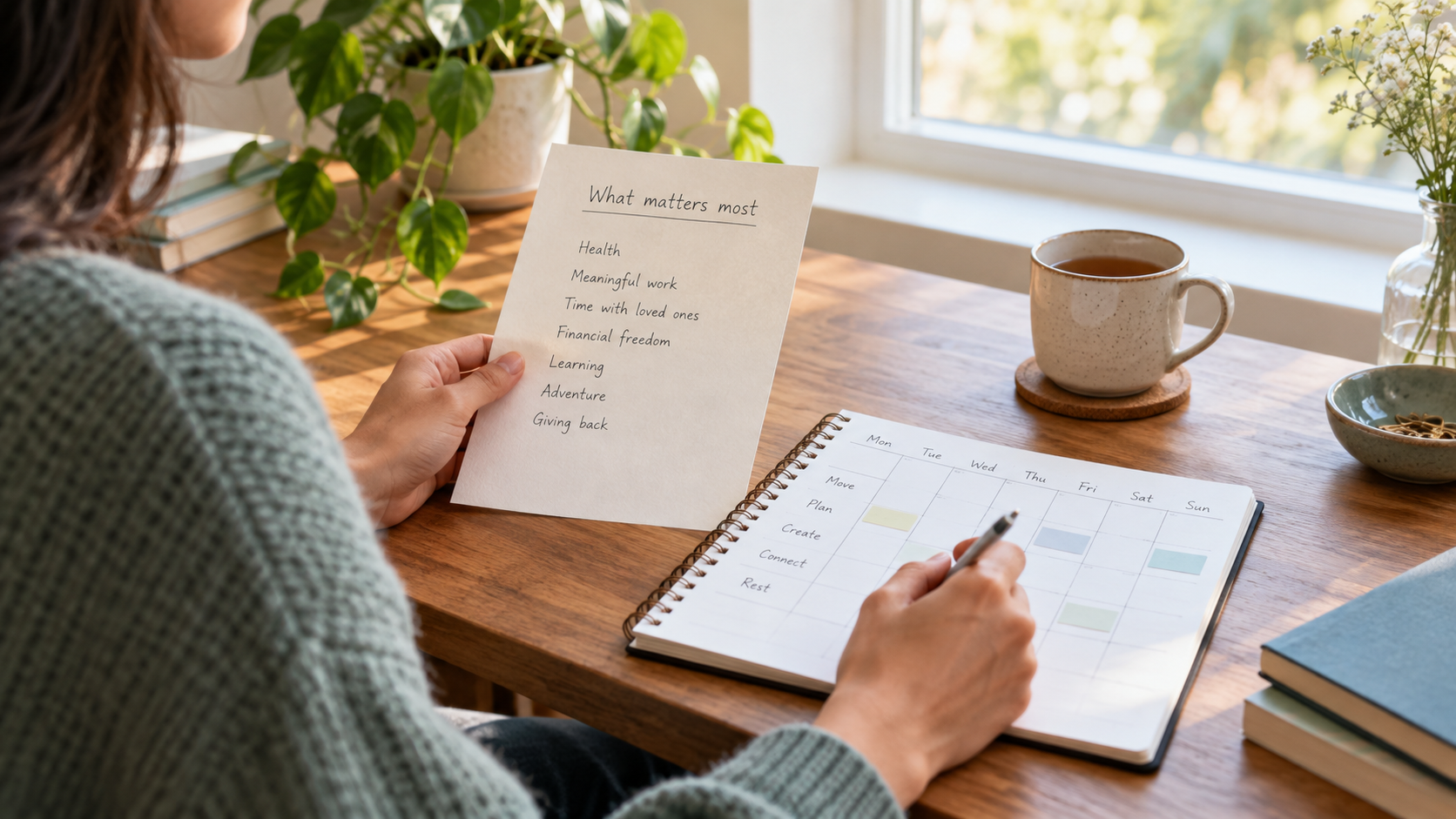
    Write one sentence that names the direction you want to move in: “I want more steadiness in my mornings,” “I want to reconnect with people,” or “I want to explore work that uses my strengths.” A direction is useful because it can guide many small choices without pretending you already know the whole route.

    Then ask what matters about that direction. You might value learning, care, security, contribution, time outdoors, or independence. Values are not a scorecard; they are a filter. When options compete, they help you compare what each option supports and what it costs.

    Turn the direction into one testable step

    Choose an action that is specific enough to put on a calendar and small enough to complete even in an ordinary week. Instead of “get healthier,” try “walk for ten minutes after lunch on Tuesday and Thursday.” Instead of “change careers,” try “speak to one person doing work I am curious about.”

    A useful first step has a clear cue, a modest scope, and a way to notice whether it happened. This aligns with the practical planning approach used in implementation-intention research: connecting an intended action to a particular situation can make follow-through more concrete.

    Run a short experiment

    Treat the first two weeks as an experiment, not a verdict on your character. Keep the question narrow: Did this action fit my real schedule? What got in the way? What made it easier? A calendar note or three-line journal entry is enough.

    Experiments are especially valuable when the choice has uncertainty. You do not need complete certainty before trying a class, a volunteer shift, a conversation, or a revised routine. You need a safe, proportionate way to learn from it.

    Make the environment do some of the work

    Willpower is a limited plan when the same obstacle appears every day. Change the surroundings where you can: place walking shoes by the door, prepare the document before a focused session, schedule the call while you have energy, or ask a friend to join you.

    Also reduce the size of the restart. Missing a day does not erase the experiment. Decide in advance on a gentle recovery action, such as doing five minutes tomorrow or rescheduling the task once. The aim is continuity, not a perfect streak.

    Review the evidence, then adjust

    At the end of the experiment, review facts before making a grand conclusion. What did you actually do? How did it affect your time, energy, or interest? Which conditions helped? Keep the step, shrink it, change its cue, or choose a different one.

    If a decision carries significant financial, legal, medical, or safety consequences, use this small-step method alongside qualified advice rather than in place of it. Good decisions can include asking for help.

    A simple weekly check-in

    • Direction: What am I trying to move toward?
    • Next step: What is one action I can schedule this week?
    • Support: What will make that action easier?
    • Learning: What will I notice after I try it?

    Life changes rarely arrive as one clean decision. More often, they are built through a series of choices that become clearer as you act. Make the next choice small enough to learn from, and let the learning shape the one after it.

    Sources

    Frequently asked questions

    1. How small should a first step be?

    It should be small enough to schedule and complete in a normal week. A concrete action gives you information that a broad intention cannot.

    2. What if I do not know my long-term goal?

    Start with a direction or value, then run a low-risk experiment. The result can help you decide what to explore next.

    3. Is it useful to write down a plan?

    Yes. Writing a specific action and its cue makes the plan easier to remember and review; implementation-intention research examines this kind of if-then planning.

    4. What if I miss the planned day?

    Use a pre-decided restart, such as rescheduling once or doing a smaller version the next day. Review the obstacle instead of treating one miss as failure.

    5. When should I ask someone for help?

    Ask when a decision involves expertise, safety, or consequences beyond your experience. Professional advice complements personal reflection and experimentation.

    6. How long should I test a new routine?

    Choose a short, defined period such as two weeks, then review what happened. Extend or adjust the experiment based on your own evidence.

  • Chakra Healing: A Comprehensive Guide to Mind–Body–Spirit Alignment

    Embarking on a journey of self-discovery and holistic well-being often begins with understanding the unseen forces that shape our lives. In recent years, the chakra system—an ancient energy framework originating in Vedic and Buddhist traditions—has captured the imagination of wellness seekers, yoga enthusiasts, and spiritual explorers worldwide. Today, we introduce a definitive guide that bridges tradition and science, offering an accessible yet in-depth exploration of chakra healing for beginners and seasoned practitioners alike.


    Why Chakras Matter in Modern Life

    At its core, the chakra system posits that seven primary energy centers run along the spine, each corresponding to specific organs, glands, and psychological patterns. When these centers flow freely, we experience physical vitality, emotional balance, and clarity of purpose. Conversely, blockages or imbalances can manifest as pain, stress, anxiety, or creative stagnation.

    This guide demystifies how chakras function not only as metaphysical concepts but also as nerve plexuses recognized by modern anatomy. By illuminating this mind–body connection, it empowers you to take charge of your wellness in a way that resonates with both ancient wisdom and contemporary research.


    A Journey Through Time: The Origins and Evolution of Chakras

    Ancient Roots

    • Vedic Scriptures: The earliest textual references to chakras appear in the Upanishads, where seers described subtle channels of energy (nadis) and focal points of consciousness.
    • Buddhist Adaptations: Later Buddhist systems integrated chakra theory into meditative practices, emphasizing visualization and breath control.

    Modern Integration

    • Yoga Revival: In the early 20th century, Western scholars and teachers popularized chakra concepts alongside Hatha and Kundalini yoga.
    • Scientific Inquiry: Recent studies have begun mapping these energy centers to ganglia and nerve clusters, validating the physical correlates of chakra theory.

    By tracing this lineage, the guide contextualizes chakra healing as a living tradition—one that continues to evolve through cross-cultural dialogue and scientific validation.


    The Seven Main Chakras: Anatomy, Emotions, and Beyond

    Each chapter delves into one chakra at a time, unpacking its unique signature:

    1. Root Chakra (Muladhara)
      • Location: Base of spine
      • Themes: Safety, grounding, survival
      • Physical Links: Adrenal glands, spine, lower back
    2. Sacral Chakra (Svadhisthana)
      • Location: Lower abdomen
      • Themes: Creativity, sexuality, passion
      • Physical Links: Reproductive system, kidneys
    3. Solar Plexus Chakra (Manipura)
      • Location: Upper abdomen
      • Themes: Personal power, confidence, will
      • Physical Links: Digestive organs, pancreas
    4. Heart Chakra (Anahata)
      • Location: Center of chest
      • Themes: Love, compassion, connection
      • Physical Links: Heart, lungs, thymus
    5. Throat Chakra (Vishuddha)
      • Location: Throat
      • Themes: Communication, truth, expression
      • Physical Links: Thyroid, vocal cords
    6. Third-Eye Chakra (Ajna)
      • Location: Between eyebrows
      • Themes: Intuition, insight, imagination
      • Physical Links: Pituitary gland, eyes
    7. Crown Chakra (Sahasrara)
      • Location: Top of head
      • Themes: Spirituality, transcendence, unity
      • Physical Links: Pineal gland, central nervous system

    For each energy center, you’ll find generously illustrated diagrams, scientific summaries linking chakras to nerve plexuses, and clear explanations of emotional patterns that may emerge when a chakra is blocked or overactive.


    Step-by-Step Practices to Balance Your Energy

    Theory comes alive through practice. This guide offers a wealth of tools to sense, assess, and harmonize your chakras:

    • Guided Meditations: Detailed scripts for color-visualization, breath-focused journeys, and body scans that help you tune into the subtle energies of each chakra.
    • Yoga Sequences: From grounding root poses (like Mountain and Warrior) to heart-opening backbends (like Camel and Bridge), every asana is chosen for its energetic effect.
    • Breathing Techniques (Pranayama): Learn how alternate nostril breathing and kapalabhati can shift stagnant energy and enhance mental clarity.
    • Crystals & Sound Therapy: Recommendations for crystals (e.g., red jasper for grounding, lapis lazuli for insight) and sound frequencies (e.g., 417 Hz for sacral release) with guidance on how to apply them safely.
    • Affirmations & Journaling Prompts: Curated phrases and reflective questions designed to rewrite limiting beliefs—“I trust my inner wisdom” for the throat, “I am connected to all life” for the heart—and foster deeper self-awareness.
    • Dietary & Lifestyle Tips: Suggestions for foods, aromas, and daily rituals to nourish each chakra, from root-fortifying root vegetables to crown-opening herbal teas.

    Throughout, sidebars highlight “Signs of Imbalance” (e.g., chronic fatigue, digestive issues, communication blocks) so you can self-diagnose and choose the right practices for your needs.


    Science Meets Spirit: Evidence-Based Insights

    While chakra work is rooted in centuries-old traditions, the guide doesn’t shy away from modern research:

    • Neuroscience & Chakra Anatomy: Summaries of studies showing how yoga and meditation can modulate the autonomic nervous system, reduce inflammation, and improve neuroplasticity.
    • Clinical Trials: Overviews of clinical findings—such as reductions in cortisol levels and improvements in immune markers—illustrating how energy-based interventions support physical health.
    • Psychological Benefits: Examinations of research on mindfulness and positive affirmations demonstrating measurable gains in emotional resilience and stress management.

    By weaving science into each chapter, the guide appeals to logical, evidence-driven readers without diluting the experiential richness of chakra work.


    Integrating Chakra Healing into Daily Life

    Transformation happens when insights become habits. The final section equips you to:

    • Create a Personal Chakra Routine: A customizable template for morning, midday, and evening practices, balancing time constraints with consistent energy work.
    • Recognize Energy Shifts: Practical tips on tuning into your body’s subtle signals—tingles, warmth, emotional releases—as you progress through your practice.
    • Deepen Your Practice: Guidance on when to seek complementary modalities (e.g., Reiki, therapeutic massage), and how to combine chakra work with journaling, creative expression, or group workshops.
    • Sustain Long-Term Growth: Strategies for tracking progress, setting intentions, and revisiting core practices when life circumstances change.

    Whether you’re aiming to soothe chronic tension, unlock creative blocks, or nurture spiritual growth, these lifestyle integrations ensure that chakra balancing becomes an empowering, lifelong journey rather than a fleeting experiment.


    Who Will Benefit from This Guide?

    • Wellness Seekers: Anyone curious about holistic health who wants clear, step-by-step tools.
    • Yoga & Meditation Practitioners: Those looking to deepen their existing practice with energy-focused techniques.
    • Energy Healers & Therapists: Professionals who wish to broaden their toolkit with evidence-based chakra protocols.
    • Curious Beginners: Readers new to subtle-energy concepts who appreciate plain-language explanations anchored in science.

    Above all, this guide speaks to the innate human desire for balance—between activity and rest, emotion and intellect, body and spirit.


    Embrace Your Inner Power

    In a world of constant stimuli and competing demands, it’s all too easy to lose touch with our own energetic blueprints. By illuminating the chakra system in its full richness—historical, anatomical, psychological, and practical—this guide offers a roadmap back to wholeness.

    As you turn each page, you’ll gain not only knowledge but also experiential confidence: the ability to feel, shift, and sustain your own energy. From the first breathing exercise to the final affirmation, you’ll discover that true balance is neither quick nor superficial—it’s the unfolding of a deeper, more vibrant you.

    Ready to transform blockages into flow, overwhelm into clarity, and tension into joy? Begin your chakra journey today and step into a life of aligned purpose, radiant health, and authentic connection.

    A Deep Dive into Chakras: Transforming Your Life Energy

    A Deep Dive into Chakras: Transforming Your Life Energy

    $5.99

    Seven centers, infinite possibility.

  • Rediscovering Midlife as Opportunity

    Whether you’re sensing the first whispers of a midlife stir or already in the thick of change, this new guide reframes the “midlife crisis” myth and shows how this season can be your most vibrant, purpose-driven chapter yet.

    Midlife often gets cast in a shadow of regret or stagnation—but beneath that reputation lies a reservoir of potential. By this point, you’ve already accumulated wisdom, cultivated resilience, and shed the weight of others’ expectations. Rather than viewing your 40s, 50s, and beyond as a downhill slide, this book invites you to harness these strengths to:

    • Reframe limiting beliefs about aging and success
    • Convert restlessness or regret into clear motivation
    • Chart a customized path aligned with your deepest values

    A Step-by-Step Roadmap

    The journey through midlife is anything but one-size-fits-all. That’s why every chapter offers practical exercises, reflective prompts, and action plans you can tailor to your own life:

    1. Awakening to Change
      Explore the subtle signs that you’re ripe for transformation—and learn how to listen when your inner voice nudges you toward something more.
    2. Myth-Busting Aging
      Dismantle cultural pressures and outdated narratives about midlife. Free yourself from stereotypes and tap into the freedom that comes with experience.
    3. Emotional Resilience Toolkit
      Cultivate emotional intelligence to navigate anxiety, restlessness, and grief—then turn those feelings into fuel for creativity and growth.
    4. Holistic Well-Being
      Build a self-care regimen—mindfulness practices, movement routines, and nutrition strategies—that keeps you energized and centered.
    5. Relationships Reinvented
      Strengthen connections with adult children, partners, friends, and colleagues through empathy, clear communication, and shared adventures.
    6. Passion Projects & Play
      Rediscover or uncover new interests with creative prompts, “mini-challenge” adventures, and exercises designed to reignite joy.
    7. Goal-Setting & Follow-Through
      Design an adaptable action plan that aligns daily habits with long-term aspirations—whether that’s a career pivot, creative endeavor, or lifestyle change.

    Why This Guide Stands Apart

    • Research-Backed & Real-World: Each strategy draws on the latest findings in psychology and wellness, illustrated by real-life success stories.
    • Flexible Formats: Short exercises fit into busy schedules; deeper dives are available when you have more time to reflect.
    • Balanced Focus: Physical health, mental well-being, relationships, creativity, and spiritual growth are all given their due—so no aspect of your life is left behind.

    Your Invitation to Thrive

    Midlife isn’t a “problem” to solve; it’s a portal to unprecedented growth. If you’re ready to:

    • Reimagine what “success” means on your own terms
    • Transform doubt into bold, confident action
    • Unlock renewed vitality, passion, and connection

    …then this guide is made for you. Embrace the freedom to rewrite your story and step confidently into your next adventure.


    Dive in today and discover how the best years of your life are still ahead.

    Rediscovering Midlife as Opportunity

    50 and Fresh: Mid-life Awakening and Empowerment

    50 and Fresh: Mid-life Awakening and Empowerment

    $5.99

    Turn Midlife Into Your Greatest Chapter