
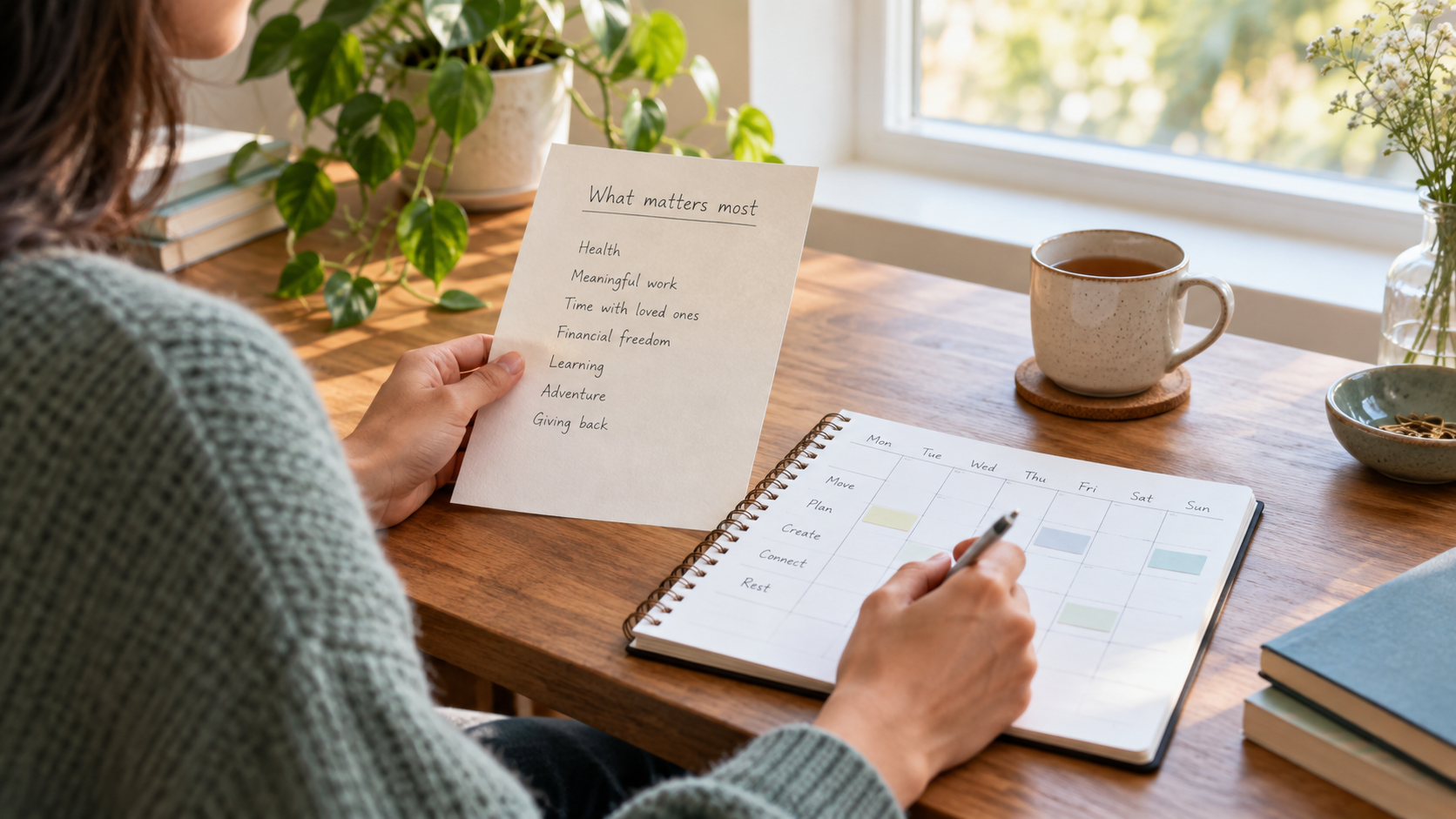
Big intentions can be energising. They can also become so broad that it is hard to know what to do before lunch. If you want to change your work, health, relationships, routines, or creative life, begin by making the next decision smaller and more visible.
This is not a promise that every change will be easy. It is a way to replace vague pressure with a process you can examine, adapt, and repeat.
Start with a direction, not a total reinvention
Write one sentence that names the direction you want to move in: “I want more steadiness in my mornings,” “I want to reconnect with people,” or “I want to explore work that uses my strengths.” A direction is useful because it can guide many small choices without pretending you already know the whole route.
Then ask what matters about that direction. You might value learning, care, security, contribution, time outdoors, or independence. Values are not a scorecard; they are a filter. When options compete, they help you compare what each option supports and what it costs.
Turn the direction into one testable step
Choose an action that is specific enough to put on a calendar and small enough to complete even in an ordinary week. Instead of “get healthier,” try “walk for ten minutes after lunch on Tuesday and Thursday.” Instead of “change careers,” try “speak to one person doing work I am curious about.”
A useful first step has a clear cue, a modest scope, and a way to notice whether it happened. This aligns with the practical planning approach used in implementation-intention research: connecting an intended action to a particular situation can make follow-through more concrete.
Run a short experiment
Treat the first two weeks as an experiment, not a verdict on your character. Keep the question narrow: Did this action fit my real schedule? What got in the way? What made it easier? A calendar note or three-line journal entry is enough.
Experiments are especially valuable when the choice has uncertainty. You do not need complete certainty before trying a class, a volunteer shift, a conversation, or a revised routine. You need a safe, proportionate way to learn from it.
Make the environment do some of the work
Willpower is a limited plan when the same obstacle appears every day. Change the surroundings where you can: place walking shoes by the door, prepare the document before a focused session, schedule the call while you have energy, or ask a friend to join you.
Also reduce the size of the restart. Missing a day does not erase the experiment. Decide in advance on a gentle recovery action, such as doing five minutes tomorrow or rescheduling the task once. The aim is continuity, not a perfect streak.
Review the evidence, then adjust
At the end of the experiment, review facts before making a grand conclusion. What did you actually do? How did it affect your time, energy, or interest? Which conditions helped? Keep the step, shrink it, change its cue, or choose a different one.
If a decision carries significant financial, legal, medical, or safety consequences, use this small-step method alongside qualified advice rather than in place of it. Good decisions can include asking for help.
A simple weekly check-in
- Direction: What am I trying to move toward?
- Next step: What is one action I can schedule this week?
- Support: What will make that action easier?
- Learning: What will I notice after I try it?
Life changes rarely arrive as one clean decision. More often, they are built through a series of choices that become clearer as you act. Make the next choice small enough to learn from, and let the learning shape the one after it.
Sources
- American Psychological Association: goals
- Gollwitzer and Sheeran, implementation intentions and goal attainment
- NICE guidance on behaviour change
Frequently asked questions
1. How small should a first step be?
It should be small enough to schedule and complete in a normal week. A concrete action gives you information that a broad intention cannot.
2. What if I do not know my long-term goal?
Start with a direction or value, then run a low-risk experiment. The result can help you decide what to explore next.
3. Is it useful to write down a plan?
Yes. Writing a specific action and its cue makes the plan easier to remember and review; implementation-intention research examines this kind of if-then planning.
4. What if I miss the planned day?
Use a pre-decided restart, such as rescheduling once or doing a smaller version the next day. Review the obstacle instead of treating one miss as failure.
5. When should I ask someone for help?
Ask when a decision involves expertise, safety, or consequences beyond your experience. Professional advice complements personal reflection and experimentation.
6. How long should I test a new routine?
Choose a short, defined period such as two weeks, then review what happened. Extend or adjust the experiment based on your own evidence.