
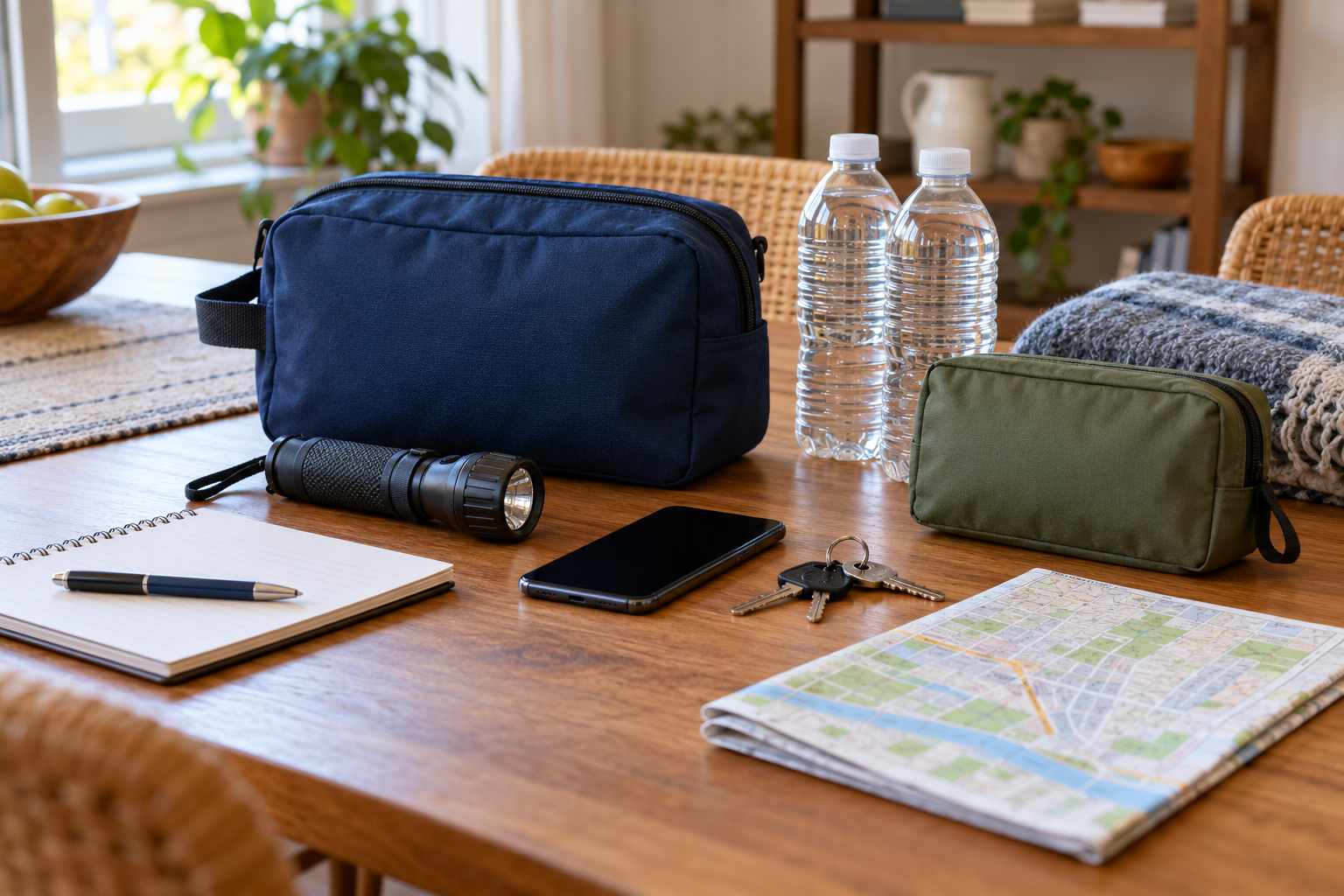
Most emergency planning fails for a very ordinary reason: it tries to solve every possible situation at once. A better starting point is a short household plan that answers a few practical questions before a storm, outage, fire, or evacuation makes those questions harder.
This is not a prediction exercise and it is not a substitute for instructions from local authorities. It is a way to make the first decisions less improvisational. A plan becomes useful when it is easy to find and easy to follow.
Start with the risks closest to home
Set aside 30 minutes with the people who live in your household. Discuss the events that are most plausible where you live, work, and spend time: perhaps severe weather, a power outage, wildfire smoke, an apartment fire, or a local evacuation. The American Red Cross recommends discussing likely emergencies, assigning responsibilities, and practicing the plan; Ready.gov similarly emphasizes planning, supplies, and staying informed.
Keep the discussion specific. Ask: What would tell us to leave? What would tell us to stay put? Who might need extra help? Where are the exits, and who is responsible for pets, medications, or children? Write brief answers rather than trying to create a perfect manual.
Choose two meeting places and one contact
Pick one meeting place immediately outside the home for a sudden event such as a fire. Pick another away from the neighborhood in case returning home is not possible. Add one out-of-area contact who can receive updates if household members are separated. Put the same names and phone numbers in each person’s phone and on a small paper card.
This small amount of redundancy matters. Batteries run down, phones get misplaced, and not everyone will be together when a disruption begins. A paper copy also gives children, guests, or a neighbor something usable without unlocking a device.
Make leaving easier, not dramatic
Write down two ways to leave your neighborhood and two possible destinations, such as a trusted friend’s home, a hotel, or an official shelter. Routes and destinations can change, so the value is in knowing what information to check and whom to contact—not in treating a page of notes as permanent instructions.
Keep keys, shoes, a phone charger, and any mobility aids in locations household members can reach. If someone uses medication, medical equipment, hearing devices, or mobility supports, include their needs in the plan and discuss supply questions with their clinician or pharmacist. Build the plan around real routines, not an imaginary household with unlimited time and storage.
Build a small, maintainable kit
A kit does not have to be bought in a single trip. Begin with items you already use: drinking water, shelf-stable food, a flashlight, spare batteries or charging options, a first-aid kit, basic hygiene supplies, and copies of key documents. Add only what suits your household, including infant supplies, pet items, glasses, prescription information, or a manual can opener where useful.
Store supplies together in a place that is easy to reach. Review food, batteries, and personal items on a calendar date you already remember, such as the start of a season or a birthday month. The Red Cross advises keeping supplies in an easy-to-carry kit that can be used at home or taken during an evacuation.
Decide how you will receive information
Agree which official sources you will check during an emergency: local emergency management, weather services, municipal alerts, school notices, or other authorities relevant to your area. Keep a battery-powered or alternative way to receive information if practical. Avoid passing along unverified social posts when people are trying to make quick decisions.
For a serious or immediate danger, contact local emergency services. Otherwise, let official instructions guide whether to evacuate, shelter, avoid travel, or seek assistance. A household plan should support those instructions, never compete with them.
Practice the parts that matter
You do not need a full-scale drill to learn whether a plan works. Try a five-minute walk-through: find the kit, unlock the exits, meet at the chosen point, and check that each person can locate the contact card. Then revise anything confusing. The Red Cross recommends practicing as many elements of a plan as possible, including evacuation routes.
Keep the final version short—one page for contacts, meeting places, responsibilities, and the kit location. Share it with anyone who regularly cares for children, pets, or a household member. The aim is quiet readiness: enough preparation to make a difficult moment more manageable.
Sources and further reading
- Ready.gov: plan ahead, build a kit, and stay informed
- American Red Cross: make and practice an emergency plan
- American Red Cross: preparedness checklist
Frequently asked questions
How long should a household emergency plan be?
Keep the working version to one page if possible. It should make contacts, meeting places, responsibilities, and kit locations quick to find; longer background notes can live elsewhere.
Should every household have the same supplies?
No. Start with basic supplies, then add items for medications, mobility, infants, pets, dietary needs, or other real household circumstances. Review needs with relevant professionals where appropriate.
Why choose an out-of-area contact?
If household members are separated, one agreed contact gives everyone a single place to leave and request updates. Make sure each person has the contact both digitally and on paper.
How often should we review the plan?
Review it after a move, a change in household members or medical needs, or a local emergency. A simple seasonal review is also a practical way to check supplies and contact details.
Do we need to practice an evacuation route?
Practicing helps reveal locked exits, missing keys, and unclear responsibilities before stress is involved. Use official directions during an actual emergency and adapt if conditions change.
Where should important documents go?
Keep copies in a secure, accessible place and include the location in the plan. Consider what you would need to identify household members, manage medications, contact insurers, or prove residence.
Leave a Reply
You must be logged in to post a comment.